MaxiLINK is MaxiLED's Data over Power protocol. Full DMX512 control travels on the same two-core electrical cable that delivers 48 VDC to the fixtures — no separate signal bus, no parallel data harness, no data terminations to fail in the wet. Fewer connections, faster installs, lower total cost, across hundreds of meters of installation.
Protected by granted patent
How it works · at a glance
One cable. Two jobs.
Where a traditional DMX install needs a power run, a separate data run, and a decoder, MaxiLINK delivers both on the same two-core cable — direct from the controller to every fixture.
Fig. 01 · Wiring comparison — traditional DMX vs MaxiLINK · data flow live
2 conductors. 2 functions.
One cable does both jobs.
The same copper pair carries 48 VDC power with the full DMX512 protocol modulated on top. No separate data bus, no decoder boxes downstream.
175 m from one source.
75 m / 246 ft leader + 100 m / 328 ft strand.
Up to 175 m (574 ft) of cable and up to 100 individually addressable fixtures from a single power-data source.
IP68 connections throughout.
One joint per fixture.
Fewer joints, fewer water-ingress failure points — designed for permanent coastal, in-grade, and submerged installations.
Inside MaxiLINK · System architecture
What it is, and how it's built.
MaxiLINK is a four-part chain. A MaxiLINK unit takes mains-fed 48 V and lays DMX 512 onto the same two conductors; a single two-core cable carries both to the strand; every fixture has an integrated receiver that reads its own address off the power line; an ELR terminates the run. That is the whole system — no separate data bus, no in-line decoders.
Fig. 02 · MaxiLINK signal chain — controller → unit → 2-core → addressable fixtures → ELR
01 · Source
The MaxiLINK unit
Combines regulated 48 VDC power and DMX 512 data onto the two conductors. A compact distribution unit — 250 W output per circuit, protected against short-circuit, open-circuit and over-temperature. Available CE (48 VDC) or UL Recognized (48 VAC).
02 · Cable
Two-core, Data-over-Power
Power and DMX 512 travel on the same two conductors — MaxiLED's patented Data-over-Power method. Data is not polarity-sensitive; fixtures tap the strand with IP68 gel connectors (BLUE − / BROWN +).
03 · Fixture
Integrated addressable receiver
Every fixture carries its own driver that reads its DMX slot straight off the power line and drives the LED. No in-line decoders anywhere on the strand.
04 · Termination
End-of-Line Resistor (ELR)
An ELR terminates the last fixture of every strand and is balanced / tuned on commissioning to keep the DMX signal clean across the full run.
The MaxiLINK unit · specifications
Two builds, one protocol.
Specification
MaxiLINK CE
MaxiLINK UL
Power input
48 VDC
48 VAC
Power output
250 W / circuit
250 W
Data input
DMX-512
DMX-512
Capacity
100 control points · 400 DMX ch
100 control points · 400 DMX ch
Max cable
100 m (328 ft)
100 m (328 ft)
Dimensions
105 × 72 × 34 mm / 1.34 in
80 × 50 × 31 mm / 1.22 in
Connector
IP68 self-locking
Junction box (by others)
Protection
Short / open / over-temp
Short / open / over-temp
Ingress
IP68
IP68 · wet location
Listing
CE
UL Recognized
Weight
400 g
400 g
Operating temp.
−25 to +50 °C / −13 to +122 °F
−25 to +50 °C / −13 to +122 °F
48 VDC · CE / 48 VAC · UL · Leader 15 m / 49 ft@1.5mm² / 75 m / 246 ft@2.5mm² · Strand ≤100 fixtures / 100 m / 328 ft · up to 175 m / 574 ft total cable · Patented Data-over-Power
The legacy DMX problem
Six reasons traditional DMX runs over budget.
01 · Skills
Installers don't know DMX.
Most electrical installers are unfamiliar with DMX termination and addressing. The skill gap produces commissioning errors — and the rework happens on the contractor's clock.
02 · Complexity
Complicated wiring schematics.
Two parallel cable systems, separate distribution boxes, parallel termination diagrams. Every junction is a place where the install can go wrong — and often does.
03 · Time
Time-consuming installs.
Twice the cables, twice the connectors, twice the terminations to test. Days of additional labor on every project — paid by someone in the chain.
04 · Materials
More cable, more accessories.
Separate data and power cabling doubles the material bill. On long runs the cost difference becomes structural, not marginal.
05 · Failure points
More electrical connections.
Every connector is a candidate for water ingress, salt corrosion, or vibration-induced loosening. More connectors, more risk of system-down events across the asset's life.
06 · Civil works
Costly cable runs and groundworks.
Trenching, conduit, and cable tray for a duplicate signal bus. On retrofits that means listed-structure intervention; on new builds, main-contractor coordination cost.
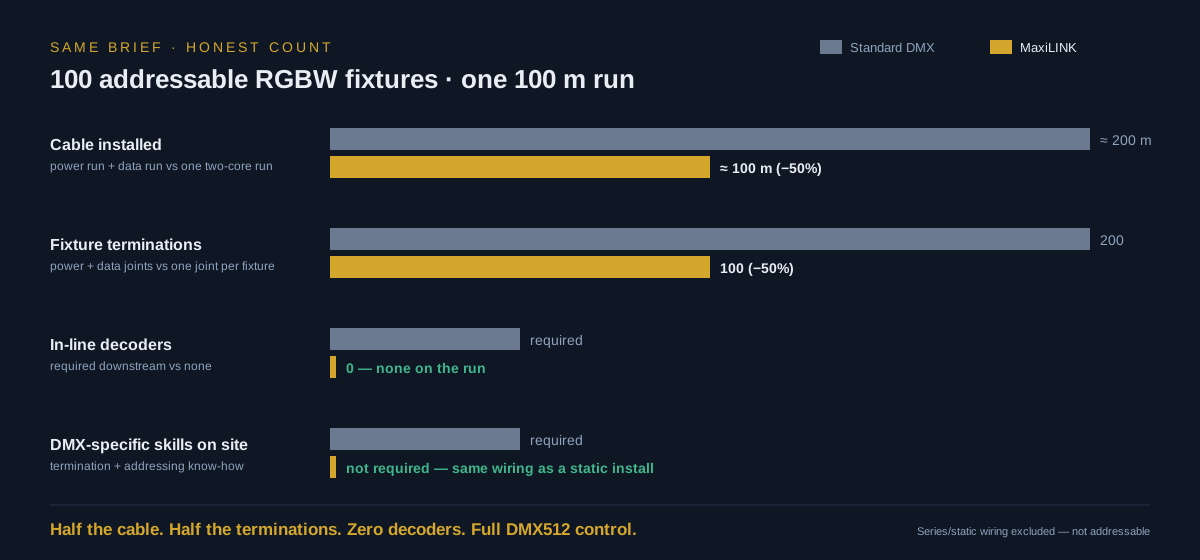
Same run · half the install
100 addressable fixtures. One 100 m run.
The brief: 100 individually addressable RGBW fixtures on one 100 m (328 ft) run. Series/static wiring is excluded — it cannot address fixtures at all. Light output is identical; what separates standard DMX from MaxiLINK is what you install, seal, and maintain.
Metric — per 100-fixture run
Standard DMX
MaxiLINK
Cable systems
2 — power + data
1 — two-core
Cable installed
≈ 200 m
≈ 100 m (−50%)
Fixture terminations
200 (power + data at each fixture)
100 (−50%)
In-line decoders
Required
None
Weatherproof joints
Two per fixture, plus decoder joints
One per fixture
DMX-specific skills on site
Required
Not required — same wiring as a static install
Half the cable. Half the terminations. Zero decoders. Full DMX512 control.
Downloads
Wiring diagrams & termination.
The three files below define how MaxiLINK gets installed and terminated. Master datasheets live on each product page.
Wiring schematics, installer training documentation, and project-specific commissioning support available from your local MaxiLED specialist. Quote turnaround typically 48–72 hours.